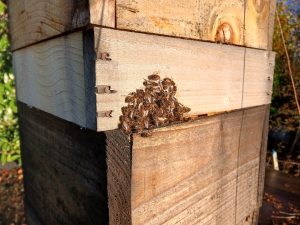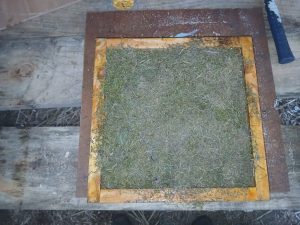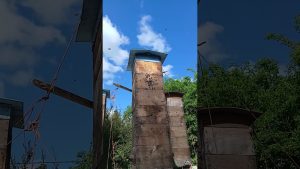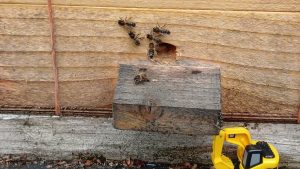
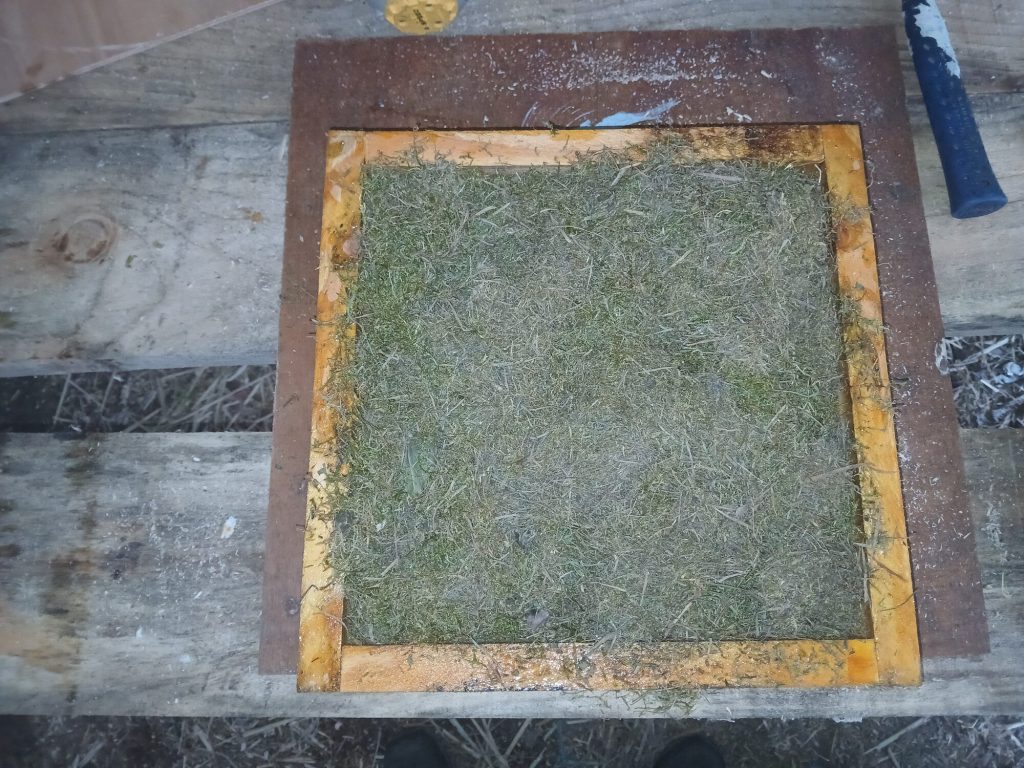
The People’s Hive has one feature that still surprises people who first meet it: a quilt. Not a bed quilt, though the idea is not far off. Abbé Émile Warré set a shallow wooden frame on top of the boxes, fixed a cloth to its underside, and filled the space with something dry and natural, such as chopped straw, dry leaves or wood shavings. In his French it is a coussin, a cushion. In English we have come to call it the quilt.
That simple lid is one of the peculiarities of Warré beekeeping, and it is the subject of a careful page in the Warré Beekeeping Archive, The quilt of the People’s Hive. The archive gathers the writing of Warré and of later natural beekeepers. It is the first place we look when we want to understand why the hive is built as it is.
Warré was keeping bees in northern France, in the Somme and later around Tours, in a milder climate than some of the places where his hive is used today. He thought of the quilt as both an insulating layer and a way for the nest to breathe. The bees cluster below. Warm, used air and moisture rise. They do not want a sealed, sweaty ceiling, and they do not want a cold draught either. The cloth at the bottom of the quilt is the membrane in between.
Writing in Beekeeping for All, in the translation by Patricia and David Heaf, Warré puts it like this:
It remains above the cluster of bees and ends up by escaping through the cloth covering the top-bars of the upper box and then passes into the quilt. And this is under the control of the bees who regulate this escape of moisture by putting more or less propolis on the cloth.
Abbé Émile Warré, Beekeeping for All, translated by Patricia and David Heaf, p. 152, as quoted in the Warré Beekeeping Archive.
That is the heart of the idea. The beekeeper provides a breathable, insulated top. The bees finish the job. They varnish the cloth with more propolis or less, according to what the colony needs. They seal what should be sealed, and they leave a little give where air and moisture need to move.
Warré suggested chopped oat straw, or sawdust, as a filling. Later keepers have used dry leaves, wood shavings, or planer shavings. One of our quilt boxes at Boglands is filled with wood shavings and covered with hessian, in the same spirit as the archive describes. The fill should stay dry and light. It is not a solid board. It is more like a hat that can still breathe.
The archive page does not stop at Warré’s own climate. It looks honestly at what happens in colder country, where moisture can condense and even freeze above the cluster, and it records how keepers such as John Moerschbacher in Alberta, Larry Garrett in Indiana, and Bruno Bec in the south of France have adapted the top of the hive. Those later experiments belong in the original piece, not here. The gem worth carrying home is the first principle: give the bees a warm, permeable crown, and let them manage it.
If you keep Warré hives, or are thinking of starting, the quilt is worth making with care. A cloth, a shallow box, and a dry natural fill are enough to begin. Then stand back, as we do at Boglands, and let the colony have its say at the top of the nest.
You can read the full piece, including Warré’s own words, the later adaptations, and the older precursors of the quilt, in the Warré Beekeeping Archive: The quilt of the People’s Hive.