Chapter 11 – Health, Pests and Diseases: Natural Approaches and the Law
In this chapter
- What bee health rests on in a natural system
- Varroa: our treatment-free, minimal-disturbance approach, and the one legal rule if you do treat
- Notifiable diseases in Ireland, and who to tell
- The Asian hornet: how to identify and report it
- Mice, wasps, badgers and wax moth
What health rests on. In this system, bee health rests on:
- local, native bees;
- fresh comb built each year as the colony moves down;
- good forage;
-
a good site.
-
above all, not being disturbed.
At Boglands we use no treatments at all. Our bees are healthy, and we believe a big part of that is that they’re left alone. Every time a hive is opened, the colony loses heat, scent and order in the nest, and it takes time to recover. A colony that is rarely disturbed can put that energy into looking after itself. Strong colonies can deal with many problems, but not with everything, so keep watching from the outside.
Varroa
The varroa mite (Varroa destructor) is everywhere in Ireland and is still the main threat to honey bees, mostly because of the viruses it spreads. Deformed wings on young bees are a warning sign.
Watch without opening the hive. If your floor has a mesh panel, slide a board under it for a week in spring and again in late summer, and count the mites that fall naturally. It tells you how a colony is doing without disturbing it.
How we work at Boglands:
- No treatments. We don’t treat our bees for varroa or anything else.
- Minimal disturbance. We open a hive only when a job has to be done. Most of what we need to know comes from the entrance and the weight.
- Local, native bees that have come through Irish winters on their own. We raise new colonies from the ones that do best (Chapter 8).
- Swarming allowed. Swarming gives the colony a natural break in brood rearing, which also breaks the mites’ breeding cycle.
- Watching. Look out for deformed wings or crawling bees at the entrance, and keep notes.
If a colony dies, close it up and remove it promptly, so robbing bees don’t carry mites or disease to other hives. Send a sample to DAFM’s free testing service if you’re unsure why it died.
The law, if anyone does treat. Only veterinary medicines authorised for honey bees in Ireland may be used (see hpra.ie), and a record of every treatment must be kept for at least five years (Regulation (EU) 2019/6, Article 108; S.I. 462/2024).
Notifiable diseases
In Ireland the following must be reported to DAFM if you suspect them (beekeeping@agriculture.gov.ie):
- American foulbrood (AFB): sunken, greasy or perforated cappings; brown, ropey larval remains that string out on a matchstick; a foul smell.
- European foulbrood (EFB): twisted, melted-looking, off-white to yellow larvae in uncapped cells; a sour smell.
- Small hive beetle (Aethina tumida): not yet found in Ireland.
- Tropilaelaps mites: not yet found in Ireland.
If you suspect foulbrood, stop and close the hive, and don’t move bees, comb or equipment. Call DAFM. Don’t shake the bees into clean equipment yourself.
DAFM’s Honey Bee Health Surveillance Programme tests samples of bees and brood for free (forms on gov.ie). It’s well worth using if anything looks odd.
Other brood problems. Chalkbrood shows as hard white or grey “mummies”. Sacbrood larvae look like little fluid-filled bags. Both often clear up when the flow improves and the colony grows.
Nosema. Nosema is a gut parasite of adult bees. It’s often worse in colonies that are stressed, damp or short of food. A dry hive, good stores and regularly renewed comb help, but they won’t cure it. Send a sample to DAFM if you’re worried.
Asian hornet
The Asian hornet (Vespa velutina, also called the yellow-legged hornet) hunts honey bees, often hovering in front of a hive. It isn’t established in Ireland, but sightings are increasing:
- 2021: a single hornet was found in Dublin.
- 2025: there were 36 confirmed sightings, and two nests were found and destroyed in Cork City and Cobh in September.
- 2026: another nest was found near Ringaskiddy, Co. Cork, in early October and removed.
How to recognise it:
- smaller than our native European hornet: workers are about 25 mm long;
- very dark, almost black body;
- one wide yellow-orange band near the tip of the abdomen;
- yellow legs;
- an orange face.
The European hornet is bigger, with a reddish-brown and yellow body and brown legs.
If you think you’ve seen one:
- Take a photo if you can do it safely.
- Report it at invasives.ie (the Asian Hornet reporter run by the National Biodiversity Data Centre).
- Then email beekeeping@agriculture.gov.ie.
Never approach or disturb a nest.
Other pests and predators
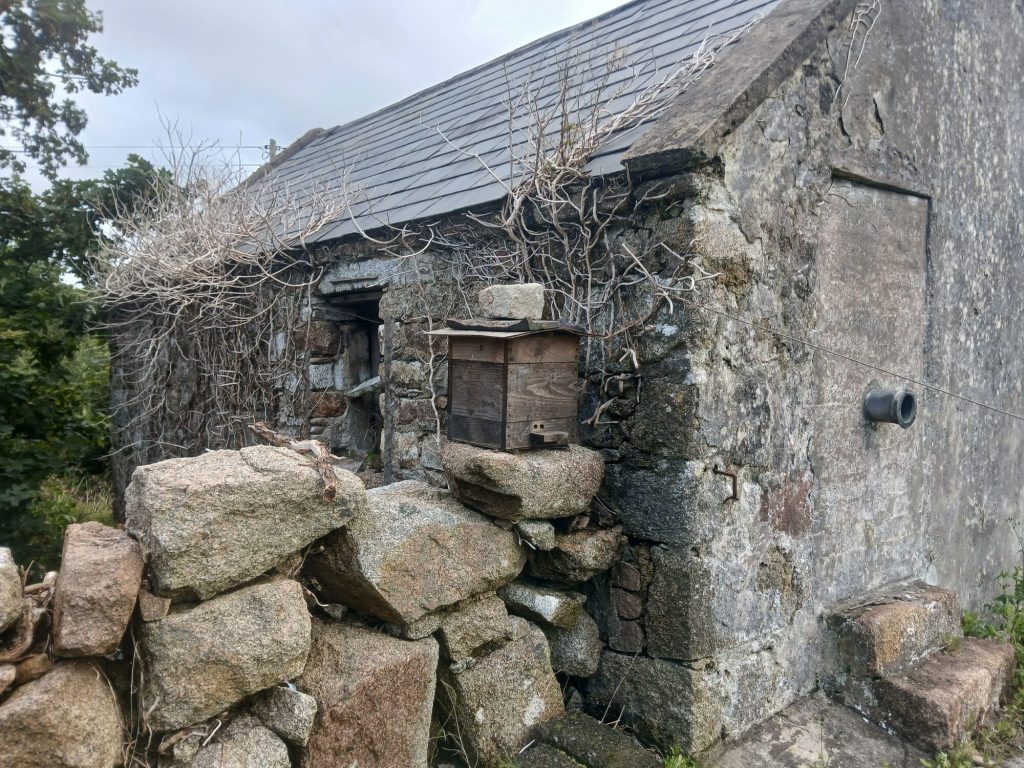
- Mice get in during autumn and nest in the quilt or in empty comb. A mouse guard keeps them out.
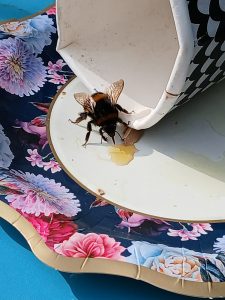
- Wasps attack weak hives in late summer. Reduce the entrance, and don’t spill honey or syrup.
- Badgers and cattle knock over stands. A high stand, strapping and fencing stop most losses.
- Wax moth damages stored comb. Keep spare boxes in a cold, bright place, or freeze the combs for 48 hours before storing them.
No treatments of any kind are part of our method. The answer is selection: breed from the colonies that survive and do well, and don’t automatically replace your losses with bought-in or imported bees.