Chapter 13 – Advanced Topics and Scaling Up
In this chapter
- Growing from a few hives to an apiary
- Queen rearing the simple way, observation windows and hybrid hives
- Selling honey and wax
- Appendices A–G: kit list, cutting list, calendar, glossary, forage plants, Irish rules, resources
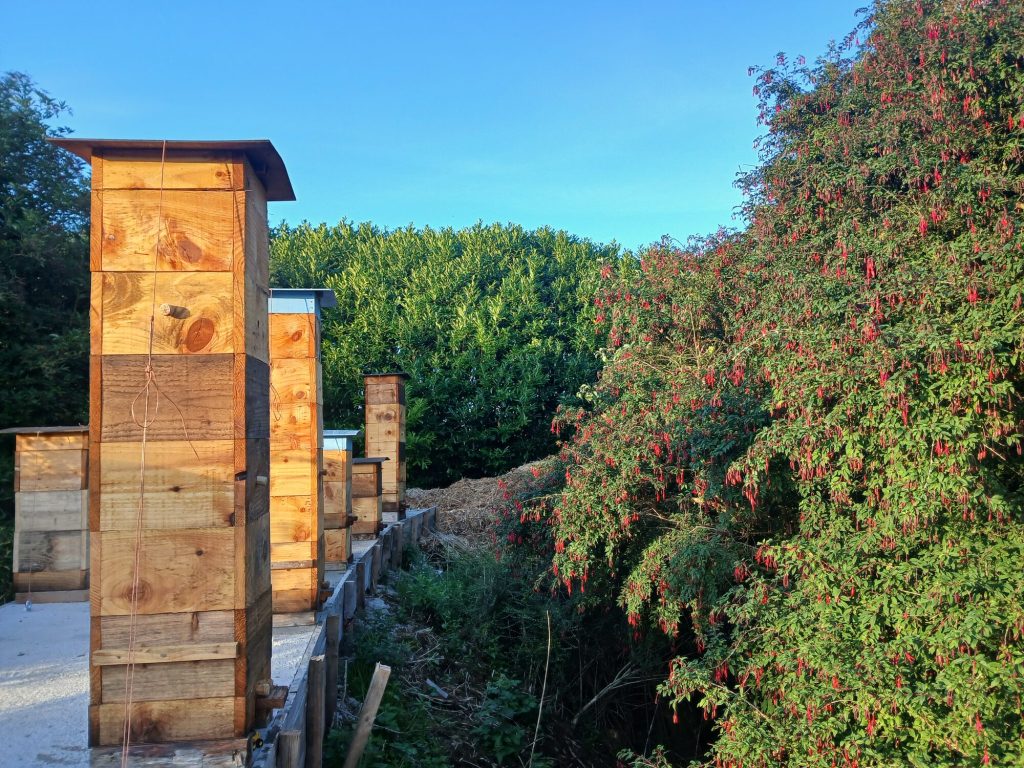
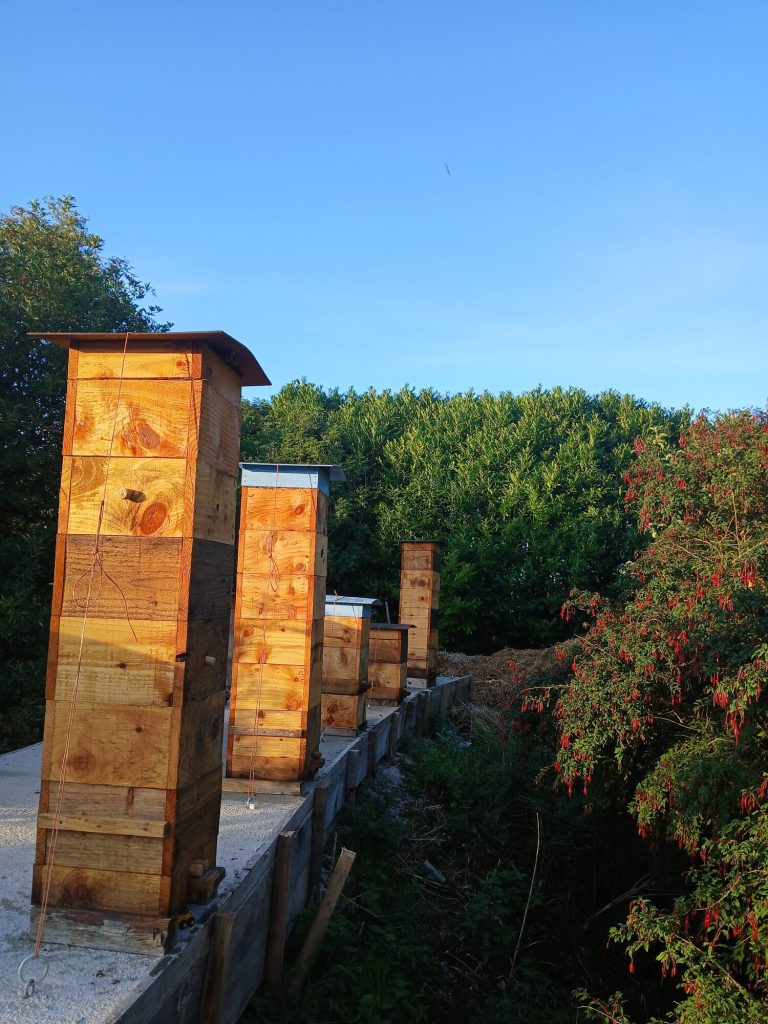
Growing. Once three or four colonies are coming through winter reliably, growing is mostly a matter of doing the same again. Keep all your equipment to one standard so any box fits any hive. A simple record of winter survival, and how much honey each hive was left with, shows you which colonies should supply the next splits.
Observation windows. A double-glazed window in one box wall, with a wooden shutter over it, is great for teaching and for checking comb without opening the hive. It’s optional. Keep the shutter closed, because a window loses heat.
Queen rearing. You can keep queen rearing low-tech. A strong colony made queenless will build queen cells, and those can be split off into nucs. Grafting and instrumental insemination are outside the original Warré spirit, but they’re possible later if you want to keep controlled native lines, and NIHBS groups do this.
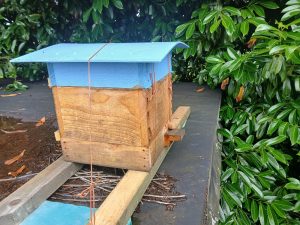
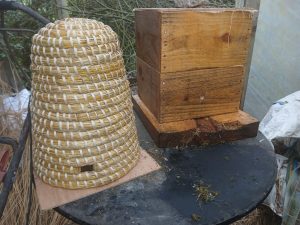
Hybrid hives. There are adapters that let you put Langstroth or National supers on a Warré. They bring back frames and extractors, so they suit keepers moving over from frame hives rather than those committed to the full Warré system.
Selling. At Boglands we currently don’t take honey from our hives. If you do and want to sell or supply it, you need DAFM registration and a correct label (Chapter 9 and Appendix F). Crush-and-strain honey sells well at farmers’ markets and the farm gate. Cut comb, chunk honey, wax blocks and candles add a bit of income.
Before you sell beyond gifts to friends, check:
- your insurance (association cover may not include selling);
- any local food-safety requirements.
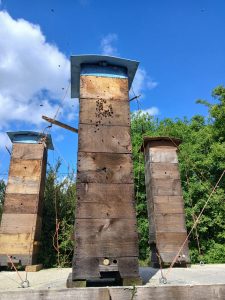
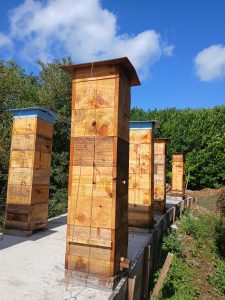
How many hives? One person can usually manage ten to fifteen Warré hives with the minimal method, if there’s enough forage. Beyond that, the time you save on each hive still adds up, but swarm season and harvest days become the bottlenecks.
The system stays the same whatever the size: space underneath, stores above, a dry quilt, local bees, and as few openings as possible.
Appendix A – Kit List
The hive (per colony)
- Stand, firm and level, 400–500 mm high
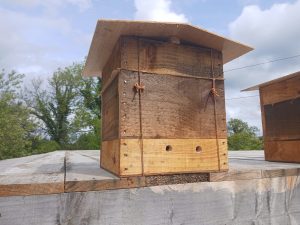
- Floor with entrance block and mouse guard (about 9.5 mm holes)
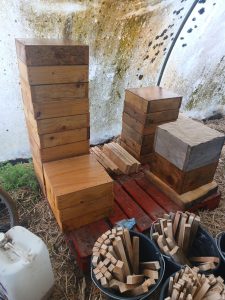
- 4 boxes with 8 top bars each, with starters
- Cloth for the top bars (hessian or cotton, about 360 × 360 mm)
- Quilt, filled with dry wood shavings or straw
- Roof
- Strap or weights for storms
For you
- Veil, plus a jacket or full suit
- Gloves
- Wellies or boots
- Smoker and fuel: dry grass, hessian, rotten wood or pine needles
- Hive tool
- Soft bee brush
- Cheese wire or a long thin knife, for separating boxes and cutting comb from the walls
- Warré hive lifter, or a strong friend, for nadiring
- Spirit level
- Luggage scale, for weighing hives
Feeding and harvest
- Fondant
- A feeder that fits in an empty Warré box
- Sugar (for 1:1 and 2:1 syrup)
- Food-grade buckets, one with a honey tap
- Coarse and fine strainers
- Jars and lids
- Labels (see Appendix F)
- Solar wax melter or an old pot for rendering wax
Safety and records
- First-aid kit with antihistamine
- Fully charged phone
- Notebook or record sheet
- DAFM registration number (only if you take honey to sell or supply)
Appendix B – Cutting List (one Warré hive, 25 mm timber)
All measurements are in millimetres, based on a 300 × 300 × 210 mm inside box with butt-jointed corners.
Before you start:
- If you use Warré’s 20 mm walls instead, the long boards become 340 mm.
- Cut all the rebates before you assemble anything.
- Check that every box is square by measuring both diagonals, which should match.
| Part | Qty | Size (L × W × T) | Notes |
|---|---|---|---|
| Box: long walls | 2 | 350 × 210 × 25 | These overlap the ends of the short walls |
| Box: short walls | 2 | 300 × 210 × 25 | Cut a 10 × 10 rebate along the top inside edge of each for the bars |
| Box: top bars | 8 | 320 × 24 × 9 | 36 mm centres; gaps about 12 mm. Add a starter strip or 2 × 2 mm wax groove |
| Box: handle cleats | 2 | 250 × 20 × 20 | Screwed to the long walls, or cut hand holds instead |
| Quilt: long walls | 2 | 350 × 100 × 25 | No rebates |
| Quilt: short walls | 2 | 300 × 100 × 25 | |
| Quilt: hessian base | 1 | about 400 × 400 | Tacked under the quilt box |
| Cloth for the bars | 1 | about 360 × 360 | Loose, under the quilt |
| Floor: board | 1 | 450 × 350 × 20 | Extra 100 mm at the front makes the landing board |
| Floor: side rims | 2 | 350 × 25 × 15 | Under the box, so it sits 15 mm off the board |
| Floor: back rim | 1 | 300 × 25 × 15 | |
| Floor: front rim | 2 | 90 × 25 × 15 | Leaves a 120 mm entrance in the middle |
| Roof | 1 | Built to fit over a 350 × 350 box | Warré pattern: pitched cap over a flat roof board, ventilated, overhanging at least 25 mm. A sheet-metal cap adds years to the roof |
Make four boxes per hive.
Assembly order:
- Cut the rebates.
- Glue and screw the box corners.
- Fit the handles.
- Wax the bars and drop them in.
- Make the quilt the same way, then tack the hessian under it.
For full roof and floor drawings, see the plans in Heaf’s translation of Beekeeping for All.
Appendix C – Month-by-Month Calendar for Ireland (Midlands)
Dates move by two or three weeks depending on the year and the site. Use your own records.
| Month | Forage | Bees | Your jobs |
|---|---|---|---|
| January | Winter heath, a little gorse | Clustered; brood starting | Leave alone. Check roofs and straps after storms. Heft. Build and repair boxes. |
| February | Hazel, gorse, snowdrops | Cleansing flights on mild days | Heft. Fondant above the top box if light. Order timber and wax. Make new roofs. |
| March | Willow, gorse, blackthorn, dandelion | Brood growing fast; stores falling | Danger month: heft weekly. Clear the entrance and dead bees. Quick look on a warm day. |
| April | Dandelion, blackthorn, cherry and other fruit blossom, sycamore | Rapid build-up; first drones | First nadir when the lowest box is about three-quarters full. Set out bait hives. Watch for swarming from mid-April. Count mite drop. |
| May | Hawthorn, sycamore, oilseed rape, horse chestnut | Swarm season peak | Nadir. Splits. Collect swarms. Check entrances weekly. |
| June | Bramble starting, clover, early lime (June gap possible) | Strong; swarms continue | Heft during the June gap. Second nadir if the flow continues. |
| July | Bramble, white clover, lime, rosebay willowherb, bell heather | Main flow | Watch for capped boxes. Start harvest late in the month in good years. No new nadirs after late July. |
| August | Ling heather on the bogs, willowherb, meadowsweet (pollen), balsam | Flow ends; drones evicted | Harvest capped surplus. Reduce entrances (wasps). Watch for deformed wings at the entrance. |
| September | Ivy, late heather, knapweed | Winter bees being raised | Finish harvest early. Check 15 kg+ stores. Feed 2:1 syrup only if light, finishing by the end of the month. Mouse guards on. |
| October | Ivy | Ivy flow; the colony shrinking | Heft. Strap down for storms. Keep the quilt dry. Watch for Asian hornets. |
| November | Ivy finishing | Clustering | Leave alone. Check after storms. |
| December | Very little | Broodless or nearly so | Leave alone. Heft. Build and repair boxes and roofs. Read and plan. |
Appendix D – Glossary
- Amm: Apis mellifera mellifera, the native dark or black honey bee of Ireland.
- Apiary: the place where hives are kept.
- Bait hive: an empty box set out to attract a swarm.
- Bee space: the gap (about 6–9 mm) that bees leave open as a walkway. Smaller gaps get glued, larger ones get comb.
- Brood: eggs, larvae and pupae.
- Capped: sealed with wax. Capped honey is ripe; capped brood is pupating.
- Cast: a later, smaller swarm, with a young unmated queen.
- Cluster: the ball of bees that keeps warm in winter.
- Cross-comb: comb built across several bars instead of along one.
- Crush-and-strain: harvesting honey by crushing the comb and straining it, with no extractor.
- Dearth: a period with no nectar coming in.
- Drone: a male bee.
- Flow (nectar flow): a period when plenty of nectar is coming in.
- Foundation: a sheet of wax embossed with cells, used in frame hives but not in Warrés.
- Heft: to judge stores by lifting the back of the hive.
- Nadir / nadiring: adding an empty box under the others.
- Nucleus (nuc): a small colony with a queen, brood and bees, usually on frames.
- Propolis: plant resin that bees collect and use as glue and sealant.
- Queen cell: a large peanut-shaped cell in which a queen is raised.
- Queenright: having a laying queen.
- Quilt: the box of shavings or straw above the top bars.
- Rebate: the step cut along a wall for the bars to sit in.
- Robbing: bees stealing honey from another hive.
- Starter: a strip of wax or wooden edge on a bar to guide the bees’ comb.
- Stores: the honey (and pollen) the colony lives on.
- Super: a box added above the brood, in a frame hive.
- Swarm: part of a colony leaving with a queen to set up a new home.
- Thixotropic: jelly-like until stirred, as ling heather honey is.
- Top bar: the wooden bar the comb hangs from.
- Varroa: the parasitic mite Varroa destructor.
- Worker: a female bee that does the work of the colony.
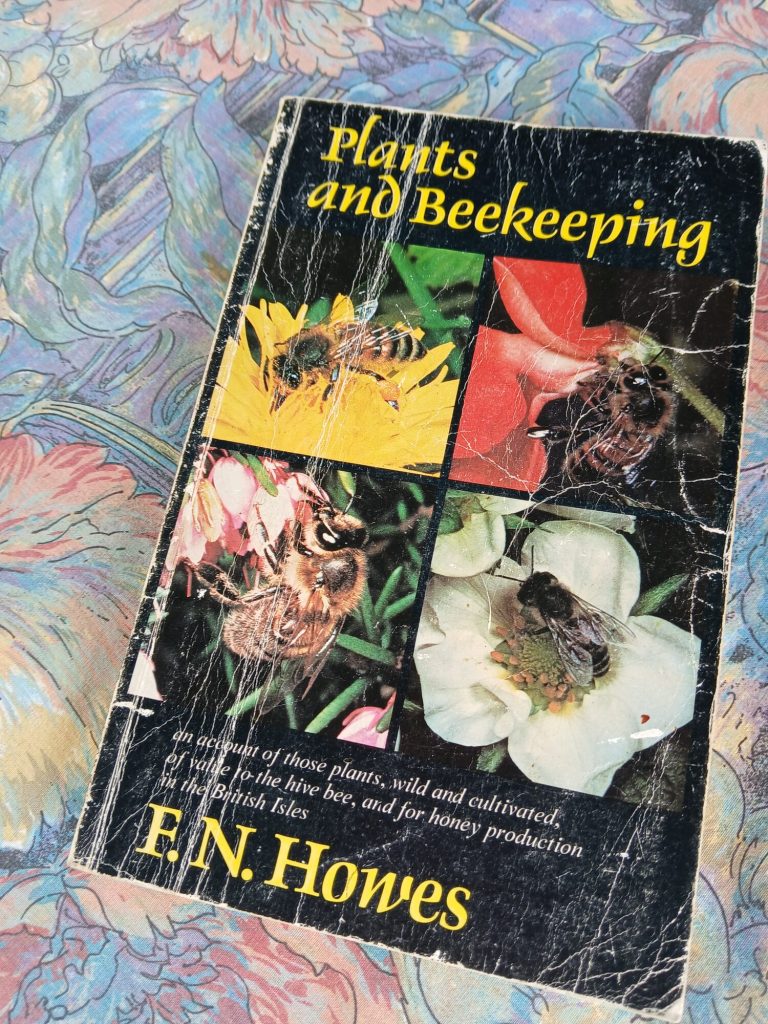
Appendix E – Bee Plants in Ireland
N = nectar, P = pollen.
| Plant | When | Gives | Notes |
|---|---|---|---|
| Willow (sally) | Feb–Apr | N, P | The most important early pollen. Plant it on damp ground. |
| Gorse (furze) | All year; peak Mar–May | P | Pollen almost year-round. |
| Blackthorn | Mar–Apr | N, P | Hedges. |
| Dandelion | Apr–May | N, P | Leave it in lawns and verges. |
| Fruit trees | Apr–May | N, P | Apple, pear, cherry, plum. |
| Sycamore | Apr–May | N, P | Can give a good early crop. |
| Hawthorn (whitethorn) | May | N, P | Some years it yields a lot, others nothing. |
| Oilseed rape | Apr–May | N, P | Where grown. The honey sets fast. |
| White clover | Jun–Aug | N | Main summer flow on grassland that isn’t heavily grazed. |
| Bramble (blackberry) | Jun–Aug | N, P | Reliable summer flow. |
| Lime | Jul | N | Big trees in towns and estates. |
| Rosebay willowherb | Jul–Aug | N | Bog roads and cutaway. |
| Meadowsweet | Jun–Aug | P | Wet ditches; pollen only. |
| Bell heather | Jul–Aug | N | Dry bog edges; runnier honey. |
| Ling heather | Aug–Sep | N | Bogs; jelly-like (thixotropic) honey. |
| Knapweed, thistles | Jul–Sep | N, P | Field margins. |
| Himalayan balsam | Aug–Oct | N, P | Invasive. Don’t plant or spread it. |
| Ivy | Sep–Nov | N, P | The vital last flow. The honey sets hard; best left to the bees. |
For more on planting for bees, see the All-Ireland Pollinator Plan (pollinators.ie).
Appendix F – Irish Rules for Beekeepers (checked October 2026)
These are summaries, not legal advice. Check gov.ie (DAFM) and hpra.ie for the current position.
- Registration (honey producers). Not all beehives need registering in Ireland. DAFM registration is tied to honey production and food business operations. If you take honey to sell or supply, you must register with DAFM as a Primary Producer of Honey (a food business operator) under the EU food hygiene rules. Without it, you can’t sell your honey legally (DAFM, Register as a Primary Honey Producer, gov.ie). Keeping bees without taking honey doesn’t need that registration. It’s free. Contact RegisterFBO@agriculture.gov.ie, or write to: Honey Registration Section, DAFM, Backweston Campus, Celbridge, Co. Kildare, W23 X3PH. Associations register their association apiaries separately.
- Notifiable diseases. You must report suspected American foulbrood, European foulbrood, small hive beetle and Tropilaelaps to DAFM at beekeeping@agriculture.gov.ie. DAFM’s Honey Bee Health Surveillance Programme tests samples free of charge.
- Medicines (only if you treat). We don’t treat at Boglands. If anyone does, only veterinary medicines authorised for honey bees in Ireland may be used (see the HPRA list), and a record of every treatment must be kept for at least five years (Regulation (EU) 2019/6, Art. 108; S.I. 462/2024).
- Asian hornet. Report suspected sightings, with a photo, at invasives.ie (the Asian Hornet reporter), then email beekeeping@agriculture.gov.ie. Never disturb a nest.
- Moving bees into Ireland. Bees coming from another EU country need a health certificate and must be notified to DAFM at least 24 hours before they arrive. Imports from outside the EU are strictly controlled. We strongly advise against importing bees at all.
-
Selling honey. You must comply with the European Communities (Marketing of Honey) Regulations 2003 (S.I. 367/2003, as amended, most recently by S.I. 591/2025, which brings in Directive (EU) 2024/1438) and the general food labelling rules (Regulation (EU) 1169/2011). The label must show:
- the name “honey” or a correct variety;
- the net weight;
- your name and address;
- the country of harvest;
- a best-before date;
- a lot mark where required.
Blends must list their countries of origin, with percentages. DAFM inspects labelling. 7. Insurance. Not a legal duty, but membership of a FIBKA or IBA association gives public liability cover for most hobby keepers. Check whether it covers courses, visitors and selling.
Appendix G – Resources
- Émile Warré, Beekeeping for All, translated by Patricia and David Heaf (free PDF online)
- David Heaf, The Bee-friendly Beekeeper and Natural Beekeeping with the Warré Hive: A Manual
- Native Irish Honey Bee Society (NIHBS): nihbs.org
- Federation of Irish Beekeepers’ Associations (FIBKA): irishbeekeeping.ie
- Irish Beekeepers Association CLG (IBA)
- DAFM, Beekeeping and Honey: gov.ie
- National Biodiversity Data Centre and invasives.ie (Asian hornet)
- All-Ireland Pollinator Plan: pollinators.ie
- Boglands Bees courses and online lessons: bees.boglands.ie
The hive this book describes isn’t the highest-yielding equipment you can buy. It’s a cavity that lets an Irish colony build, winter and reproduce, with the keeper as an occasional helper rather than a weekly manager. That was Warré’s aim, and it still fits a bog-edge apiary in Offaly.
Mike Davies, Boglands Bees, Boglands, Daingean, Co. Offaly