Chapter 1 – The History and Philosophy of the Warré Hive
In this chapter
- Who Abbé Warré was and what he was trying to do
- How the hive copies a hollow tree
- The five principles of the system: natural comb, top bars only, nadiring, the quilt and few inspections
Who was Abbé Warré?
Émile Warré was born in 1867 at Grébault-Mesnil in the Somme, in northern France, and died at Tours in 1951. He was a Catholic priest who kept bees for most of his life. By his own account he studied some 350 hives of different systems before settling on his own design. He set it all out in L’Apiculture pour Tous (Beekeeping for All), which ran to twelve editions; the last was in 1948. The English translation by Patricia and David Heaf is freely available online and is still the best place to start.
Warré wasn’t trying to get the most honey possible from each colony for sale. He wanted a hive an ordinary rural household could build cheaply, run without special equipment and mostly leave alone, while still getting a modest, reliable crop.
A hive shaped like a hollow tree
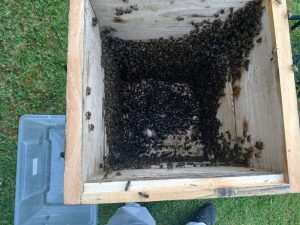
Warré watched how wild colonies live. They prefer a tall, narrow cavity. The comb hangs from the top, the brood sits in the lower and middle combs where the temperature is steadiest, and honey is stored above and to the sides. Bees in the wild don’t build on wax sheets stamped with a cell size chosen by a manufacturer, and nobody breaks their nest into rectangles and rearranges it every week.
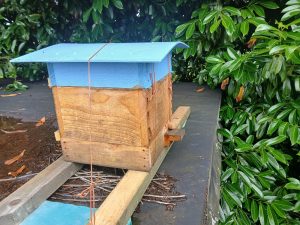
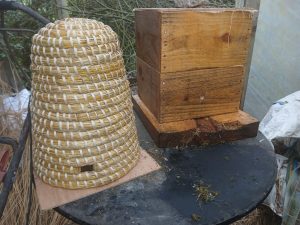
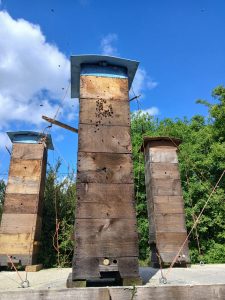
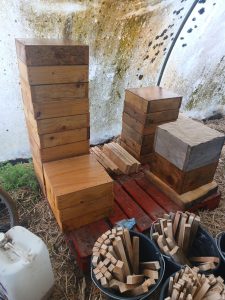
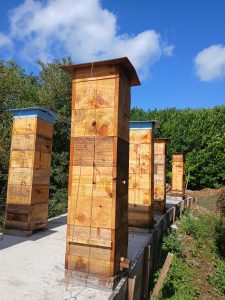
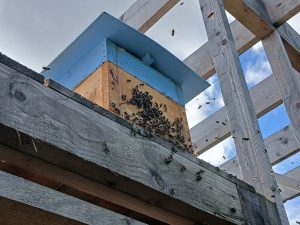
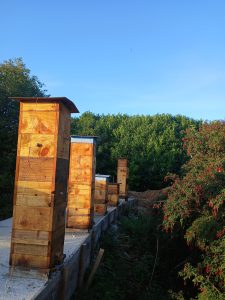
So his hive is a stack of small square boxes with fixed top bars and no frames or foundation. The bees draw their own comb from a thin wax starter strip or a bevelled edge on each bar. The beekeeper makes room by putting an empty box underneath the brood (this is called nadiring) rather than on top. That leaves the heat, scent and brood nest undisturbed. Honey is taken from the top box once it’s fully capped and the colony doesn’t need it.
His motto was simple: let the bees do the work. In practice that means accepting a smaller average harvest than an intensively managed frame hive. It means some colonies will swarm, and your main tools are timing, good local bees and a good site, not weekly inspections and chemical treatments.
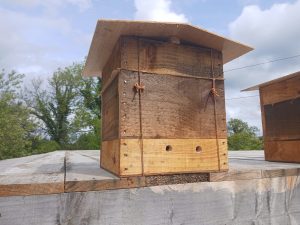
The floor of Warré’s hive has a plain slot entrance. Above the bars he put a quilt filled with straw or wood shavings to soak up moisture, and he topped the lot with a pitched roof. Here in Ireland we keep all of that and add mouse guards, stands high enough to keep badgers off, and sometimes a landing board.
The five principles
- Natural comb, no foundation. The bees choose their own cell sizes. Worker comb, drone comb and transition cells appear where the colony needs them. New comb is drawn in the lower boxes each year and moves upward. Old dark comb is retired naturally when the top boxes are harvested.
- Top bars only. Each box holds eight bars, 24 mm wide, at 36 mm centres. There are no frames to break, no foundation to wire and no extractor to buy.
- Nadiring. Empty boxes go on the bottom. The rule in this book is: nadir in spring when the lowest box is about three-quarters full of comb. This matches the way bees naturally build downward and keeps the queen and brood in one warm, unbroken column. See Chapter 8.
- The quilt. A shallow box filled with shavings or straw sits above the top bars, with a cloth between. It soaks up the large amount of water vapour a colony gives off. In a damp Irish winter that matters even more than extra insulation.
- Few inspections. You read the entrance, judge the weight of the boxes and lift a box gently now and then, instead of pulling every comb. You open the hive only for a real reason.
Warré’s book is still the main source. Later writers, notably David Heaf in The Bee-friendly Beekeeper and Natural Beekeeping with the Warré Hive, recorded how the hive does in the milder, wetter climate of Britain and Ireland.
The hive isn’t magic. Colonies still die of starvation, queen failure or varroa if the keeper ignores stores or buys bees from heavily treated stock. Used the way Warré meant it to be, the hive simply takes away several of the stresses that conventional equipment puts on bees.